The History of Revere Ware: From Paul Revere’s Legacy to America’s Most Trusted Copper-Bottom Cookware
The history of Revere Ware begins not in 1939, but centuries earlier with the legacy of Paul Revere, the Revolutionary War patriot whose metalworking mastery inspired a brand that would define American cookware. When Revere Brass & Copper Corporation introduced its first copper-clad stainless steel cookware line at the New York World’s Fair in 1939, the company borrowed more than a name — it inherited a tradition of craft and durability that Paul Revere himself embodied as a silversmith and copper artisan in colonial Boston.
What started as a single product line became a national phenomenon, weathering world wars, manufacturing shifts, and changing ownership while remaining a fixture in millions of American homes. Understanding the history of Revere Ware means tracing how innovation, wartime necessity, and brand evolution shaped the copper-bottom pots and pans that generations of home cooks still reach for today.
Paul Revere’s Metalworking Legacy and the Brand’s Founding
Paul Revere operated a copper rolling mill in Canton, Massachusetts, beginning in 1801 — the first of its kind in North America. His metalworking expertise extended far beyond the famous midnight ride: Revere produced copper sheathing for ship hulls, church bells, and even the copper plating for the original dome of the Massachusetts State House. When Revere Brass & Copper Corporation formed in 1929 through a merger of several metalworking firms, it claimed direct lineage to Revere’s original mill.
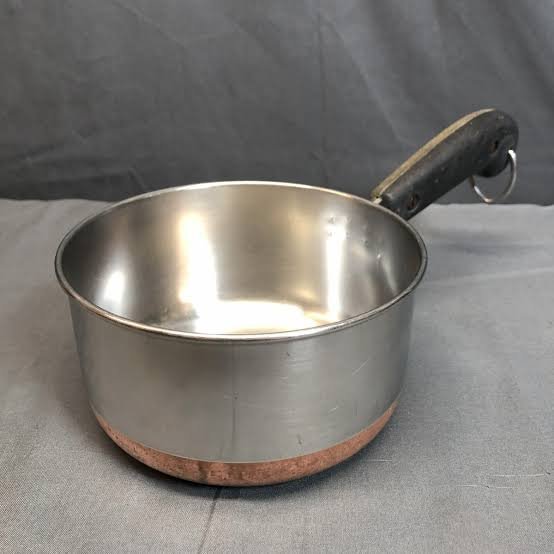
The company’s decision to enter the cookware market in 1939 capitalized on both that heritage and a materials breakthrough. Revere Ware’s signature design — stainless steel bodies with copper-clad bottoms — combined the easy maintenance of stainless with copper’s superior heat conductivity. The copper layer wasn’t purely decorative: it distributed heat more evenly than steel alone, reducing hot spots and giving home cooks more control over temperature-sensitive tasks.
The World’s Fair Debut
Revere Ware launched at the 1939 New York World’s Fair, where its pavilion showcased the copper-bottom cookware as modern American innovation. The bakelite handles, red in early production runs, represented another forward-looking choice: heat-resistant plastic handles were still uncommon in cookware, and the phenolic resin used could withstand stovetop temperatures without warping. That debut year established the product’s identity as both practical and distinctly American, themes the brand would return to throughout its marketing life.
World War II Production and the Return to Consumer Manufacturing
When the United States entered World War II in 1941, Revere Ware’s Clinton, Illinois, manufacturing plant shifted entirely to military production. The company produced field mess kits, canteens, medical instruments, and ammunition cartridges, suspending civilian cookware output for the duration of the war. Copper, critical for electrical wiring and munitions, became tightly rationed, making the copper-bottom design impossible to produce even if consumer demand had been permitted.
Production resumed in 1946, but post-war Revere Ware showed subtle differences from its pre-war predecessor. Early pre-1968 Revere Ware pieces featured thicker copper cladding and heavier-gauge stainless steel, a construction standard that collectors and longtime users prize for its durability and even heating. The bakelite handles transitioned from red to the more familiar brown and eventually to black phenolic resin, though the essential design — the flared lip, the distinctive circular mark on the copper bottom — remained consistent.
Post-War Market Dominance
The late 1940s and 1950s saw Revere Ware become nearly ubiquitous in American kitchens. The cookware appeared in wedding registries, department store displays, and home economics classrooms. Revere’s marketing emphasized both the Paul Revere heritage and the product’s practicality: copper bottoms eliminated the need for constant heat adjustment, and stainless steel required no polishing or special care beyond ordinary washing. By the mid-1960s, Revere Ware was one of the best-selling cookware lines in the United States, a position it would hold for decades.
Manufacturing Changes and Ownership Transitions After 1968
The year 1968 marks a turning point in Revere Ware’s construction standards. Cost pressures and rising copper prices led the company to reduce the thickness of the copper cladding on the bottom of its cookware, a change that longtime users and vintage collectors can feel in the weight difference between pre- and post-1968 pieces. The copper layer remained, but its reduced mass conducted and retained heat less effectively, subtly altering the cookware’s performance.
Ownership of the Revere Ware brand changed hands multiple times after the original parent company began divesting non-core assets. Corning acquired the line in 1988, sold it to World Kitchen in 1998, and the brand eventually passed to other licensees over the following decades. Each transition brought production adjustments: manufacturing moved from the original Illinois plant to offshore facilities, and design tweaks appeared in handle styles, copper application methods, and the stainless steel alloy formulations.
The Vintage Revere Ware Collector Market
Pre-1968 Revere Ware pieces, particularly those from the 1940s and 1950s, now command premium prices in vintage cookware markets. Collectors prize the heavier construction, thicker copper bottoms, and often the original bakelite handles that have survived decades of use. Identification marks stamped into the cookware — including the circular logo, patent numbers, and ‘Process Patent’ or ‘Des. Patent’ text — help date pieces and distinguish early production runs from later iterations. The enduring appeal of vintage Revere Ware speaks to both nostalgia and genuine performance advantages: many home cooks find that older pieces outperform modern equivalents in heat distribution and long-term durability.
Why Revere Ware’s Design Endured Across Generations
Revere Ware succeeded not because it introduced revolutionary technology, but because it applied existing materials intelligently and marketed the result as accessible American quality. Copper-bottom cookware existed before 1939, but earlier versions typically featured full copper construction or required frequent polishing to maintain appearance. Revere’s stainless steel body eliminated tarnish concerns while retaining copper’s thermal advantages where they mattered most — in contact with the heat source.
The design’s simplicity also contributed to its longevity. Revere Ware pots and pans had no complex mechanisms, no non-replaceable parts beyond the handle attachment, and no special cleaning requirements. A saucepan from 1950 functions identically in 2025 if the copper bottom remains intact and the handle secure. That practical durability, combined with the brand’s association with Paul Revere’s legacy and American manufacturing tradition, kept Revere Ware relevant even as cookware materials and kitchen trends evolved through stainless clad aluminum, hard-anodized finishes, and non-stick coatings.
The history of Revere Ware reflects broader shifts in American consumer products: the rise of branded household goods in the mid-20th century, the impact of wartime production on civilian manufacturing, and the trade-offs between cost reduction and quality that accompanied globalization. For many families, a set of Revere Ware represented both a practical kitchen investment and a tangible connection to a brand rooted in American history — a combination that remains compelling even as the cookware market grows ever more crowded.
A Legacy Measured in Decades of Daily Use
The history of Revere Ware is a story of how thoughtful design and genuine material advantages can sustain a product through generations, even as manufacturing and ownership shift. From its 1939 debut as a symbol of modern American innovation to its status today as both functional cookware and collectible vintage artifact, Revere Ware succeeded by solving real problems — uneven heating, tarnish, durability — without requiring users to master complicated care routines.
What makes the brand’s history compelling isn’t just the Paul Revere connection or the World War II production chapter, but the fact that millions of home cooks continue to use Revere Ware pots and pans decades after they were manufactured. That longevity speaks to a balance of material choice, construction quality, and practical design that few cookware brands achieve. Whether you inherited a set from a grandparent or discovered pre-1968 pieces at an estate sale, understanding where Revere Ware came from helps explain why it remains relevant in an era of endless cookware options.
Notes
Revere Ware’s original Clinton, Illinois, manufacturing plant closed in the early 1990s, though the exact date varies by source. By the late 1980s, production had already begun shifting to facilities outside the United States under Corning’s ownership. Subsequent owners continued offshore manufacturing, meaning most Revere Ware sold after the mid-1990s was produced internationally, though the brand name and basic design elements persisted.
Vintage Revere Ware, particularly pieces made before 1968, features significantly thicker copper cladding on the bottom and heavier-gauge stainless steel throughout. The copper layer in pre-1968 cookware conducts heat more effectively and retains temperature better than later production runs. Handle materials also evolved from early bakelite to phenolic resin, and some handle attachment methods changed over the decades. Collectors and experienced users often report that pre-1968 pieces outperform modern versions in heat distribution and durability.
Paul Revere’s copper rolling mill, established in 1801 in Canton, Massachusetts, became the foundation for later metalworking companies that eventually merged to form Revere Brass & Copper Corporation in 1929. While Revere himself never made cookware, his pioneering work in American copper production and metalworking excellence provided both the technical heritage and the brand identity that the company invoked when launching its cookware line in 1939. The connection is historical and symbolic rather than direct product lineage.
Revere Ware pieces carry stamped markings on the bottom that indicate manufacturing era. Early pieces show ‘Process Patent’ or specific patent numbers, while mid-century production often includes ‘Revere Ware’ in a circular logo with ‘Rome N.Y.’ or ‘Clinton ILL.’ location stamps. The style and color of the handle, the thickness of the copper bottom, and the presence or absence of certain design features all help narrow the production date. Pre-1968 pieces typically have noticeably heavier copper cladding and bakelite or early phenolic handles.
The core Revere Ware line always centered on copper-bottom stainless steel construction, but the company did produce other cookware types over the decades. Some specialty pieces used aluminum, and Revere briefly experimented with porcelain enamel-coated steel and fully-clad tri-ply construction in later years under different ownership. However, the signature copper-bottom design remained the brand’s defining product, and most vintage and collectible Revere Ware refers specifically to that stainless-and-copper combination.
Vintage Revere Ware works safely on gas and electric coil stovetops, but compatibility with glass-top electric and induction ranges varies. The copper-clad stainless steel bottom is magnetic and can work on some induction cooktops, though performance depends on the stainless steel alloy and the thickness of the base. On smooth glass-top electric ranges, the copper bottom’s tendency to leave marks or residue may require extra care. As long as handles remain secure and the copper cladding is intact, vintage Revere Ware functions as effectively as when it was new, often better than post-1968 production due to the thicker copper layer.